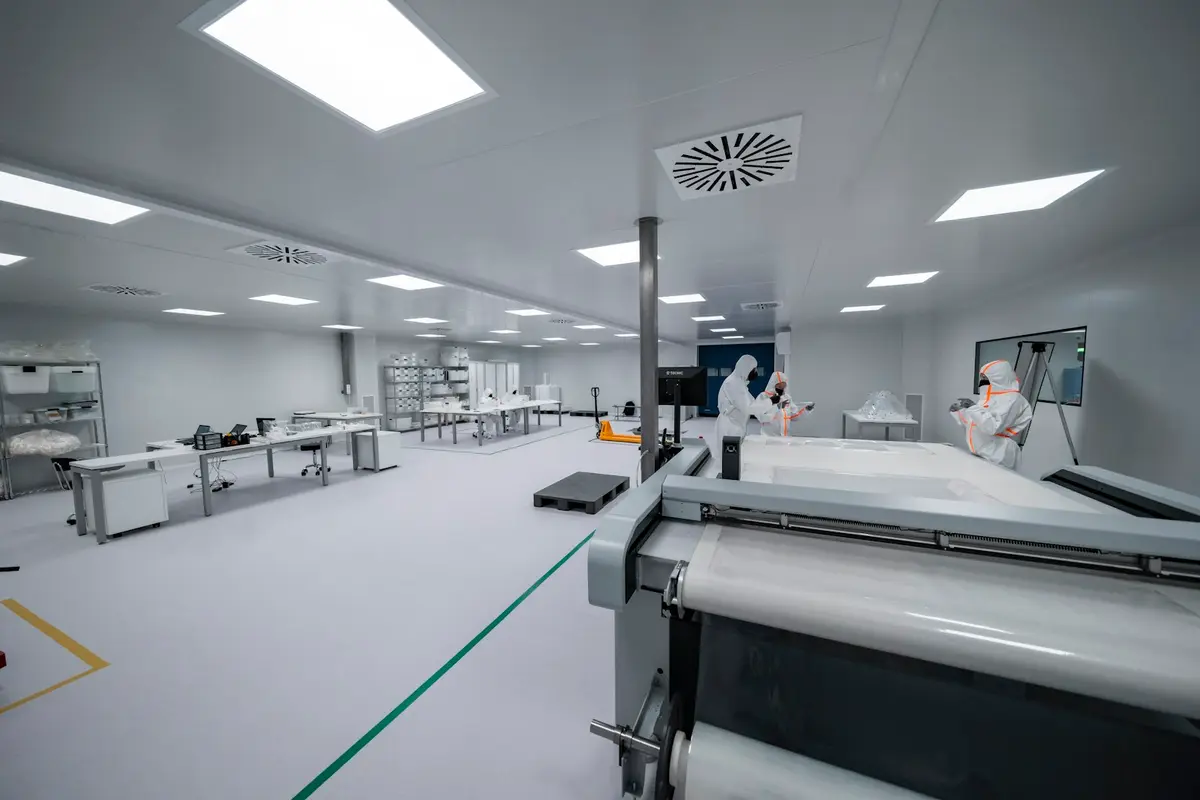
Cleanroom zoning is the first design decision that locks in cost and schedule on a pharmaceutical project. Assign a grade, and you have committed to an air change rate, a pressure regime, an airlock, and a monitoring plan for that room. Get a classification wrong and the correction usually lands during qualification, when it is most expensive to fix. This guide covers how EU GMP grades relate to ISO 14644 classes, what the classification states mean, and how pressure cascades and airlocks turn a list of grades into a working zoning plan.
Key takeaways
- GMP cleanroom classification assigns EU GMP grades A, B, C or D (or ISO 14644 classes) to each room based on the process step performed there.
- Grade A equals ISO 5 both at rest and in operation; Grade B is ISO 5 at rest and ISO 7 in operation; Grade C is ISO 7 / ISO 8; Grade D is ISO 8 at rest.
- EU GMP Annex 1 gives a guidance value of 10–15 Pa between adjacent rooms of different grades, maintained through cascade, sink, or bubble airlocks.
- Since the 2023 Annex 1 revision, every classification, pressure, and flow decision has to be justified in a documented Contamination Control Strategy.
What is GMP cleanroom classification?
GMP cleanroom classification is the process of assigning a cleanliness grade to each room in a pharmaceutical facility according to the airborne particle and microbial limits it must meet. It links the manufacturing step to a defined environment: an aseptic filling point needs Grade A, while a room for washing components can be Grade D.
Two standards frame the decision. ISO 14644-1 defines cleanliness classes ISO 1 to ISO 9 by the maximum concentration of particles of a given size per cubic metre of air. EU GMP Annex 1 adds the pharmaceutical grades A, B, C and D, and ties each grade to both a particle class and a set of microbial monitoring limits. In the United States, the FDA aseptic processing guidance uses the ISO classes directly (ISO 5, ISO 7, ISO 8).
Classification is not the same as zoning. Classification says how clean each room must be; zoning arranges those rooms so that people, materials, and air move between grades without carrying contamination. A facility with correct grades but a broken flow will still fail.
What are cleanroom Grades A, B, C and D?
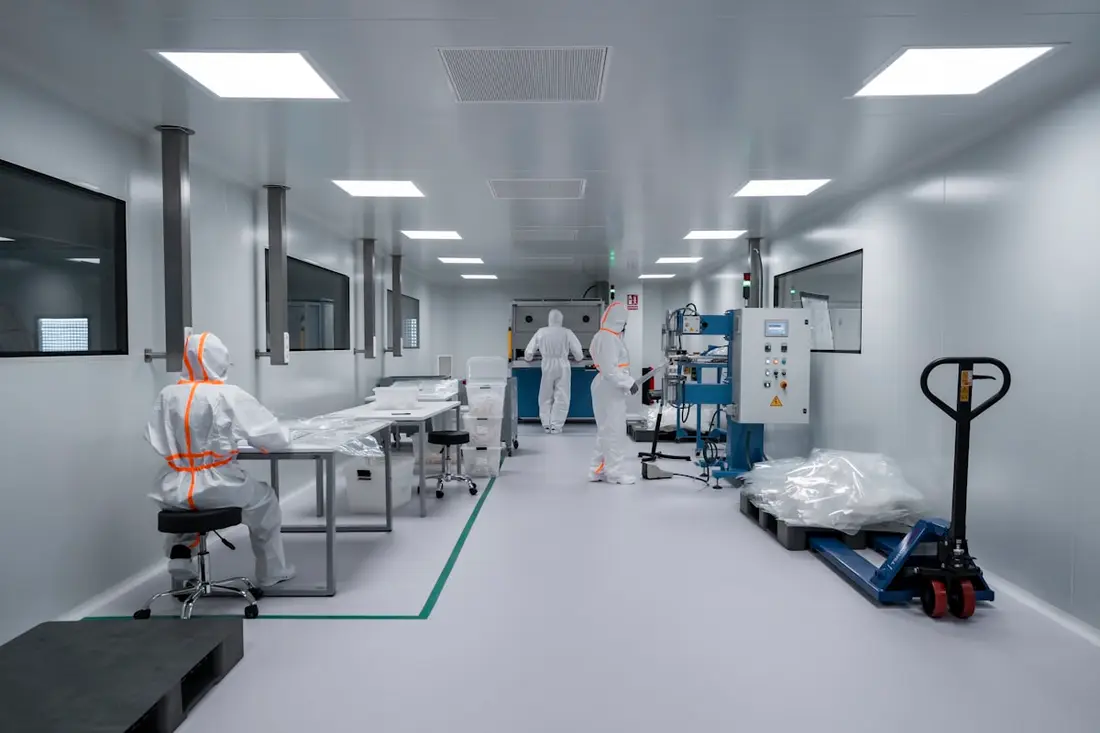
EU GMP Annex 1 defines four grades for sterile manufacturing, each mapped to an ISO 14644 particle class that the room must hold in two states — "at rest" (equipment running, no staff) and "in operation" (normal activity under way).
| Grade | At rest | In operation | Typical use |
|---|---|---|---|
| A | ISO 5 | ISO 5 | Aseptic filling and connections, under unidirectional airflow |
| B | ISO 5 | ISO 7 | Background environment around Grade A during aseptic processing |
| C | ISO 7 | ISO 8 | Solution preparation before sterile filtration; filling non-sterile products |
| D | ISO 8 | Set from the CCS | Component washing, equipment assembly, early preparation steps |
The at-rest and in-operation split matters because a room is qualified against both. A Grade B room that meets ISO 5 empty but drifts past ISO 7 once four gowned operators are working is not compliant, no matter how good the at-rest data looks.
How do EU GMP grades map to ISO 14644 classes?
Each GMP grade corresponds to an ISO 14644-1 class, but the mapping changes between the at-rest and in-operation states. Grade A and Grade B at rest both sit at ISO 5; Grade C in operation and Grade D at rest sit at ISO 8. As a reference, the ISO 14644-1 limit for particles ≥0.5 µm per cubic metre is 3,520 at ISO 5, 35,200 at ISO 6, 352,000 at ISO 7, and 3,520,000 at ISO 8 — each class an order of magnitude dirtier than the one before.
The practical point is that a single label like "Grade C" implies two different particle targets depending on whether people are in the room. Annex 1 also applies microbial limits (settle plates, contact plates, air sampling) that ISO 14644 does not address at all, so the GMP grade is always the stricter, more complete specification for a pharmaceutical room.
What is a pressure cascade in a cleanroom?
A pressure cascade is a deliberate series of pressure differences between adjacent rooms so that air always flows from cleaner to less-clean spaces, never the reverse. EU GMP Annex 1 gives a guidance value of 10–15 Pa between adjacent rooms of different grades, with the higher-grade room held at higher pressure.
The cascade is built outward from the cleanest room. A Grade B aseptic core might sit at +45 Pa relative to the unclassified corridor, with each airlock stepping down 10–15 Pa. When a door opens, the pressure difference collapses briefly; airlocks and interlocks give the system time to recover before the next door moves. For handling potent compounds or live organisms, the cascade is inverted so the process room is at lower pressure and hazardous material stays contained — a decision that has to be reconciled with the sterility requirement in the Contamination Control Strategy.
How do airlocks work between cleanroom grades?

An airlock is a small room with interlocked doors that separates two areas of different grade and holds the pressure cascade during a transfer. EU GMP Annex 1 describes three airlock concepts, chosen according to the contamination risk on each side.
- Cascade airlock: pressure steps down through the airlock, from the cleaner room toward the less-clean room. The standard choice for aseptic areas.
- Sink airlock: the airlock is at lower pressure than both adjacent rooms, drawing air inward from both sides. Used to contain a hazard.
- Bubble airlock: the airlock is at higher pressure than both adjacent rooms, pushing air outward to both sides. Used to protect a clean room while also containing an adjacent process.
Facilities separate personnel airlocks (PAL) from material airlocks (MAL) so that gowning and equipment transfer do not interfere. Undersized airlocks are a frequent qualification problem: if the room is too small to hold its pressure while a door is open, the cascade fails every time material moves.
How do personnel and material flows affect zoning?
Zoning only works if the flows through it are unidirectional in principle: people and materials should progress from lower to higher grade through defined gowning and transfer steps, and waste and used equipment should leave by a separate route. Annex 1 expects the facility layout to prevent flows of different cleanliness from crossing.
This is where a grade list becomes a floor plan. Each doorway between grades needs an airlock; each airlock needs space and a pressure regime; each change of direction in a corridor is a chance for a personnel route to cross a waste route. Modelling the flows against the zoning during design is far cheaper than discovering a cross-over during the qualification walkthrough. For the air side of the same problem, see our guide to cleanroom HVAC design.
Common GMP zoning mistakes
Most zoning problems are set in the first weeks of design and surface months later. The recurring ones:
- Treating classification as a labelling exercise instead of a commitment to air changes, pressure, and monitoring.
- Under-sizing airlocks so they cannot hold the pressure cascade during transfers.
- Ignoring the in-operation state and qualifying only at rest.
- Letting personnel, material, and waste flows cross because the layout was fixed before the flows were mapped.
- Designing the pressure scheme without a Contamination Control Strategy to justify each value.
Zoning decisions made in the first week of design can save, or cost, months during qualification.
Frequently asked questions
What is the difference between GMP grades and ISO 14644 classes?
ISO 14644-1 classifies a cleanroom by airborne particle concentration alone, on a scale from ISO 1 to ISO 9. EU GMP Annex 1 grades (A, B, C, D) map to ISO classes but add microbial monitoring limits and separate "at rest" and "in operation" requirements. For a pharmaceutical room the GMP grade is the governing specification; ISO 14644 is cited for the particle classification method.
Which ISO class is a Grade C cleanroom?
A Grade C cleanroom must meet ISO 7 at rest and ISO 8 in operation for particles ≥0.5 µm, meaning up to 352,000 particles per cubic metre when idle and up to 3,520,000 during activity. Grade C also carries microbial action limits. It is typically used for solution preparation before sterile filtration and for filling non-sterile products.
What does "at rest" and "in operation" mean?
"At rest" is the state where the cleanroom is complete, the HVAC and equipment are running, but no staff are present. "In operation" is normal production activity with the defined number of operators working. EU GMP Annex 1 requires cleanrooms to be classified and to hold their grade in both states, because personnel are the largest source of contamination.
How many pascals should there be between cleanroom grades?
EU GMP Annex 1 gives a guidance value of 10–15 Pa between adjacent rooms of different grades. The cleaner room is normally held at higher pressure so air flows outward. Airlocks maintain the difference during transfers, and pressure is continuously monitored and alarmed. For containment of hazardous material the cascade is reversed so the process room is at lower pressure.
What is a Contamination Control Strategy?
A Contamination Control Strategy (CCS) is a facility-wide document, required by the 2022 revision of EU GMP Annex 1, that describes how every design and procedural control works together to prevent contamination. Classification, pressure cascades, airflow, flows, and gowning all have to be justified within it rather than set by default values.
Do all pharmaceutical cleanrooms use Grades A to D?
No. Grades A to D come from EU GMP Annex 1 and apply to sterile medicinal products. Non-sterile manufacturing, packaging, and many biotech operations are classified against ISO 14644 or against national guidance using ISO classes. The four-grade system is specific to sterile processing, though its zoning principles carry over.
How PharmaTwin helps
PharmaTwin is a pharmaceutical facility simulator that assigns ISO and GMP grades as you place rooms, then checks the consequences in real time. It validates pressure cascades, airlock placement, and personnel and material flows against the grades you set, so classification and zoning errors surface at the design stage instead of during qualification.