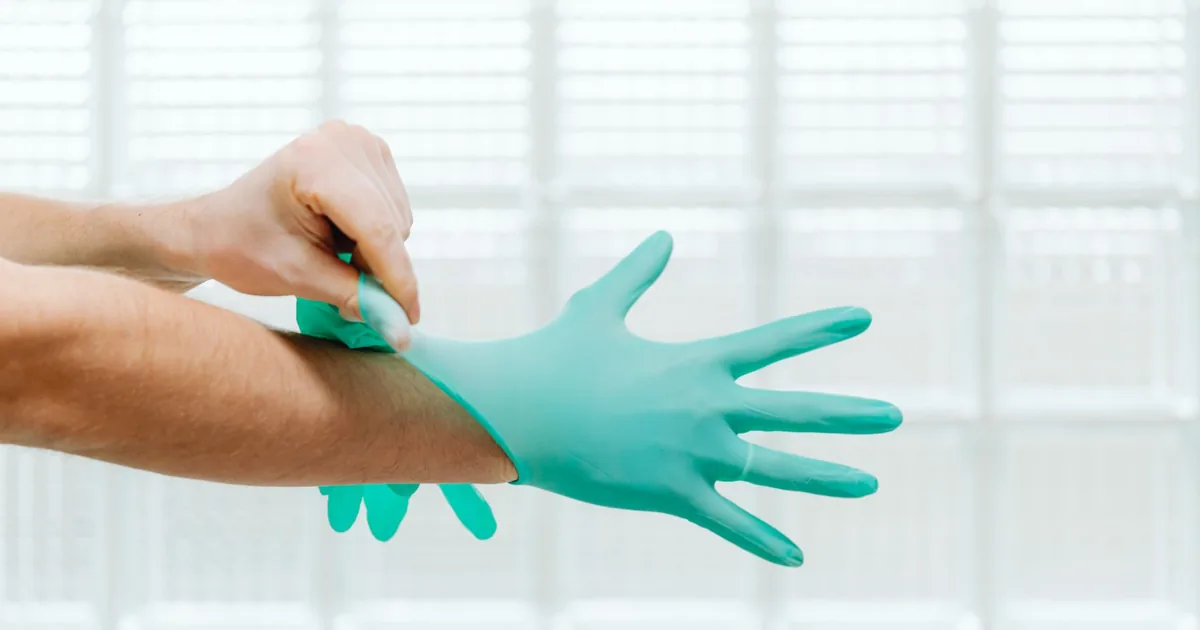
Cleanroom gowning is the controlled sequence in which personnel put on cleanroom garments before entering a classified area, so that particles and microorganisms shed by the body stay inside the clothing. In pharmaceutical manufacturing, EU GMP Annex 1 (2022) describes the garments expected for each grade and the change rooms they are donned in. This guide covers both sides: what operators wear, and how the gowning room has to be laid out for the procedure to work.
Key takeaways
- EU GMP Annex 1 (2022), paragraph 7.13, describes typical clothing for each grade: a general protective suit in grade D, a trouser suit gathered at the wrists in grade C, and a sterilised suit, hood, facemask, eye coverings, over-boots and two pairs of sterile gloves in grade B.
- ISO 14644-1 classifies air cleanliness by particle concentration. It does not prescribe garments, so "ISO 7 gowning requirements" always come from a GMP text or a site procedure.
- Gowning rooms are personnel airlocks. Their final stage must be, at rest, the same grade as the cleanroom it leads to (Annex 1, 4.12).
- Operators entering grade A and B areas must pass a gowning assessment that is repeated at least annually and includes visual and microbial checks (Annex 1, 7.4).
What is cleanroom gowning?
Cleanroom gowning is the step-by-step donning of dedicated garments, in a change room, before entering a clean area. Its purpose is to put a barrier between the operator and the product: Annex 1 expects protective clothing to minimise the shedding of fibres and particles and to retain the particles shed by the body. People are the main source of contamination in a cleanroom, which is why gowning is one of the personnel controls an inspector looks at first.
Gowning is not only a procedure. It depends on garments that have been qualified, on a change room of the right grade, and on operators who have been trained and assessed. Annex 1 treats all three as part of the contamination control strategy (CCS).
What are the gowning requirements for each cleanroom grade?
The requirements become stricter with each grade: the garment covers more of the body, and from grade B onwards everything worn is sterilised. EU GMP Annex 1 (2022), paragraph 7.13, gives a description of typical clothing for each grade, summarised below. Grade A is entered only through interventions from grade B, so the grade B description applies to both.
| Grade | Hair and face | Suit | Footwear | Gloves |
|---|---|---|---|---|
| D | Hair, beards and moustaches covered | General protective suit | Disinfected shoes or overshoes | Where the CCS identifies a contamination risk |
| C | Hair, beards and moustaches covered | Single or two-piece trouser suit, gathered at the wrists, high neck | Disinfected shoes or overshoes | Where the CCS identifies a contamination risk |
| B (and interventions into A) | Sterile headgear enclosing all hair, sterile facemask and sterile eye coverings covering all facial skin | Sterilised suit worn over dedicated undergarments | Sterilised footwear such as over-boots, trouser legs tucked in | Two pairs of sterile, non-powdered gloves; sleeves tucked into the second pair |
Two further rules apply to the higher grades. Outdoor clothing, including socks, must not be brought into changing rooms that lead directly to grade B and C areas; facility suits covering the full length of the arms and legs, and facility socks, are worn before entering them (7.14). And every operator entering grade B or A must gown in clean, sterilised garments at each entry (7.15).
ISO classes are a different matter. ISO 14644-1 sets particle limits and says nothing about clothing. By particle concentration at 0.5 µm, grade B corresponds to ISO 5 at rest and ISO 7 in operation, grade C to ISO 7 at rest and ISO 8 in operation, and grade D to ISO 8 at rest. Outside GMP, sites usually build their gowning levels on industry guidance such as IEST-RP-CC003, which is a recommended practice and not a regulation. The grade logic itself is explained in our guide to GMP zoning and cleanroom grades.
What is the correct order of gowning?
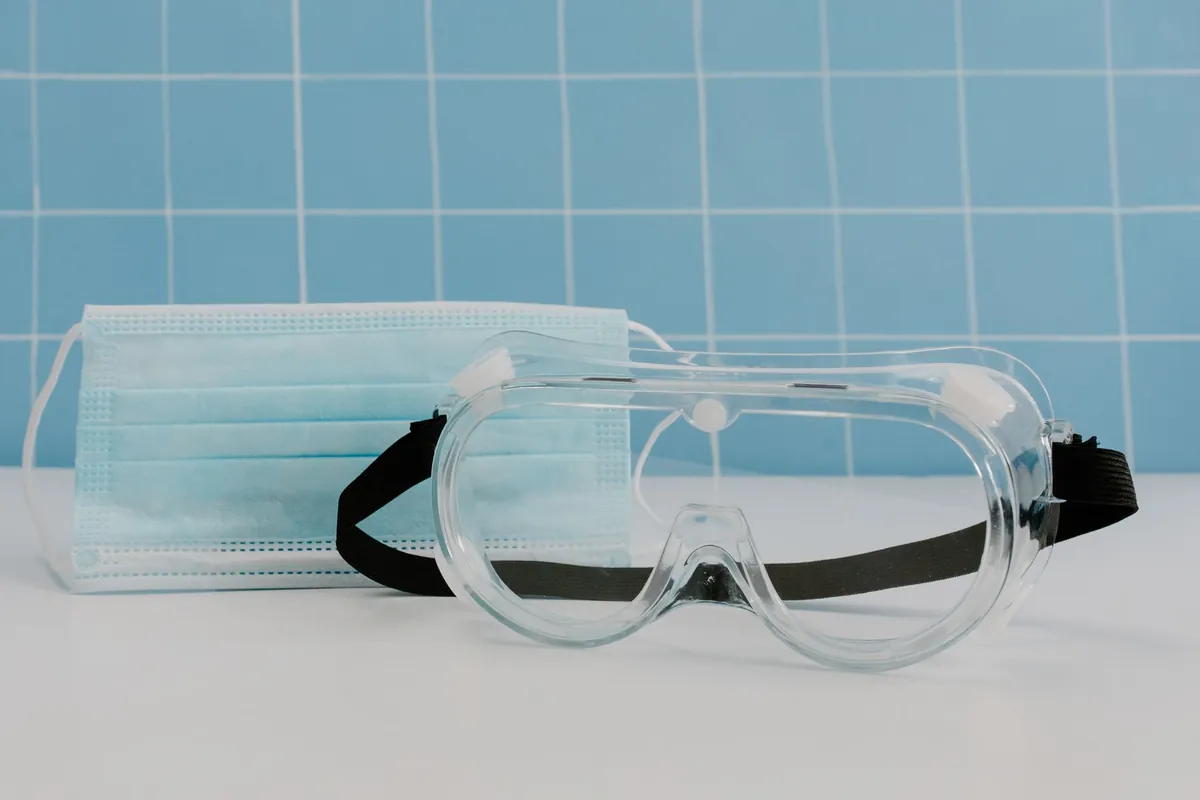
The correct order runs from the head down and from the least clean step to the cleanest, so that each item covers the one before it and nothing clean touches the floor or the skin. Annex 1 fixes some of the details but not the full sequence; the site procedure does. A typical sequence for entry to a grade B area is:
- Remove outdoor clothing, jewellery, watches and make-up (Annex 1, 7.9), and put on the facility suit and socks.
- Wash and dry hands in the first stage of the changing room, then cover hair and beard.
- Put on a first pair of sterile gloves. Annex 1 expects sterile gloves to be worn while donning the sterilised garments.
- Put on the sterile hood and facemask.
- Put on the sterilised suit, touching only its inner surface and keeping it off the floor. The headgear is tucked into the neck of the suit.
- Put on over-boots while crossing the step-over bench, with the trouser legs tucked inside.
- Put on sterile eye coverings so that no facial skin is exposed.
- Put on the second pair of sterile gloves over the sleeves, check the gown for integrity, and disinfect the gloves before entering.
Garments are visually checked for cleanliness and integrity immediately before and after gowning, and gown integrity is checked again on exit (Annex 1, 7.11). De-gowning follows a defined order too, preferably in a separate exit route.
How should a gowning room be designed?
A gowning room should be designed as a staged personnel airlock, with each stage cleaner than the one before and no route back across the clean side. Annex 1 (4.12) describes personnel airlocks as areas of increasing cleanliness, for example from grade D to grade C to grade B, and requires the final stage to be, in the at-rest state, the same grade as the cleanroom it leads to.
The points that most often decide the layout are these:
- Hand washing in the first stage only. Annex 1 (4.12) says sinks should generally not be present in changing rooms that give direct access to grade B.
- Separate entry and exit. Separate change rooms for entering and leaving grade B are described as desirable; where that is not practical, entry and exit are separated in time by procedure.
- Interlocked doors. Both doors of an airlock must not open at the same time. An interlock is expected for airlocks leading to grade A and B, and at least a visual or audible warning for grade C and D (4.13).
- Air and pressure. The airlock is flushed with filtered air, and adjacent rooms of different grades keep a pressure difference of at least 10 Pa, a guidance value (4.14).
- Room size. A step-over bench, garment storage, waste bins and a mirror all need floor space, and so does the number of people gowning at shift change. An undersized gowning room becomes a queue, and queues lead to shortcuts.
Personnel and material routes should stay apart wherever possible, which we cover in the cleanroom airlock design guide. The supply air needed to hold the final stage at grade follows the same rules as any other classified room; see cleanroom HVAC design.
How are gowning and garments qualified?
Gowning is qualified twice: once for the person and once for the garment. For personnel, Annex 1 (7.4) requires compliance with aseptic gowning procedures to be confirmed by an assessment and a periodic reassessment at least annually, with both visual and microbial checks at locations such as gloved fingers, forearms, chest and hood. The limits are the contact plate and glove print limits of Table 6.
| Grade | Contact plate (55 mm), CFU per plate | Glove print (5 fingers, both hands), CFU per glove |
|---|---|---|
| A | No growth | No growth |
| B | 5 | 5 |
| C | 25 | Not specified |
| D | 50 | Not specified |
Unsupervised access to grade A and B areas is restricted to people who have passed the gowning assessment and taken part in a successful aseptic process simulation. In routine production, gloves and gown are monitored on each exit from the grade B cleanroom (9.25). The US FDA guidance on aseptic processing likewise expects an initial gowning qualification with microbiological sampling of the gown, followed by periodic requalification.
For garments, qualification covers particle shedding and retention, the maximum time a sterilised gown may be worn during a shift, and the maximum number of laundry and sterilisation cycles (7.13, 7.15 and 7.17). Reusable clothing is processed in a laundry that is segregated from production. Full text: EU GMP Annex 1 (2022).
Common gowning mistakes
Most gowning findings come from the room and the routine, not from the garment. The recurring ones are:
- A final change room that is one grade below the cleanroom it serves, so the gown is contaminated before entry.
- A sink in the stage that opens onto grade B.
- Entry and exit sharing one room with no separation in time, so used gowns cross clean ones.
- No mirror or no second person to check the gown, leaving exposed skin around the eyes and wrists.
- Garments with no defined limit on wear time or laundry cycles.
- Gowning qualification done once at hiring and never repeated.
Frequently asked questions
What is the correct order of gowning for a cleanroom?
Gowning runs from the head down and from the least clean step to the cleanest. For a grade B area: hand washing and hair cover in the first stage, then a first pair of sterile gloves, sterile hood and facemask, the sterilised suit, over-boots at the step-over bench, eye coverings, and a second pair of sterile gloves over the sleeves. The site procedure sets the exact order.
What are the gowning requirements for an ISO 7 cleanroom?
ISO 14644-1 sets particle limits, not garments, so there is no single ISO 7 rule. In EU GMP terms ISO 7 is the at-rest limit of grade C, where Annex 1 describes covered hair and beard, a trouser suit gathered at the wrists with a high neck, and disinfected shoes or overshoes. It is also the in-operation limit of grade B, which needs full sterile gowning.
What are the gowning requirements for an ISO 5 cleanroom?
In pharmaceutical manufacturing, ISO 5 corresponds to grade A and to grade B at rest. EU GMP Annex 1 describes a sterilised suit, sterile headgear enclosing all hair, a sterile facemask and eye coverings, sterilised over-boots and two pairs of sterile gloves, put on fresh at each entry. Outside GMP, the site procedure defines the gowning level.
What are the gowning requirements for an ISO 8 cleanroom?
ISO 8 is the at-rest limit of grade D and the in-operation limit of grade C. For grade D, EU GMP Annex 1 describes covered hair, beards and moustaches, a general protective suit and disinfected shoes or overshoes. Gloves and a facemask are added when the contamination control strategy identifies an activity as a contamination risk.
What is a gowning room?
A gowning room, or change room, is a personnel airlock where operators put on cleanroom garments before entering a classified area. It is usually split into stages of increasing cleanliness. Under EU GMP Annex 1, its final stage must be, at rest, the same grade as the cleanroom it leads to, and its doors must not open at the same time.
How often does gowning have to be requalified?
EU GMP Annex 1 (2022), paragraph 7.4, requires compliance with aseptic gowning procedures to be reassessed at least annually for personnel accessing grade A and B areas. The assessment is both visual and microbial, with samples from locations such as gloved fingers, forearms, chest and hood. An adverse monitoring trend can trigger disqualification and requalification earlier.
How PharmaTwin helps
PharmaTwin is a pharmaceutical facility simulator in which change rooms are modelled like any other classified room. You can lay out the gowning stages, assign a grade to each, and check the pressure cascade, air change rates and personnel flows they produce before the layout is frozen. It does not replace the gowning procedure or operator qualification; it helps make sure the room supports them.