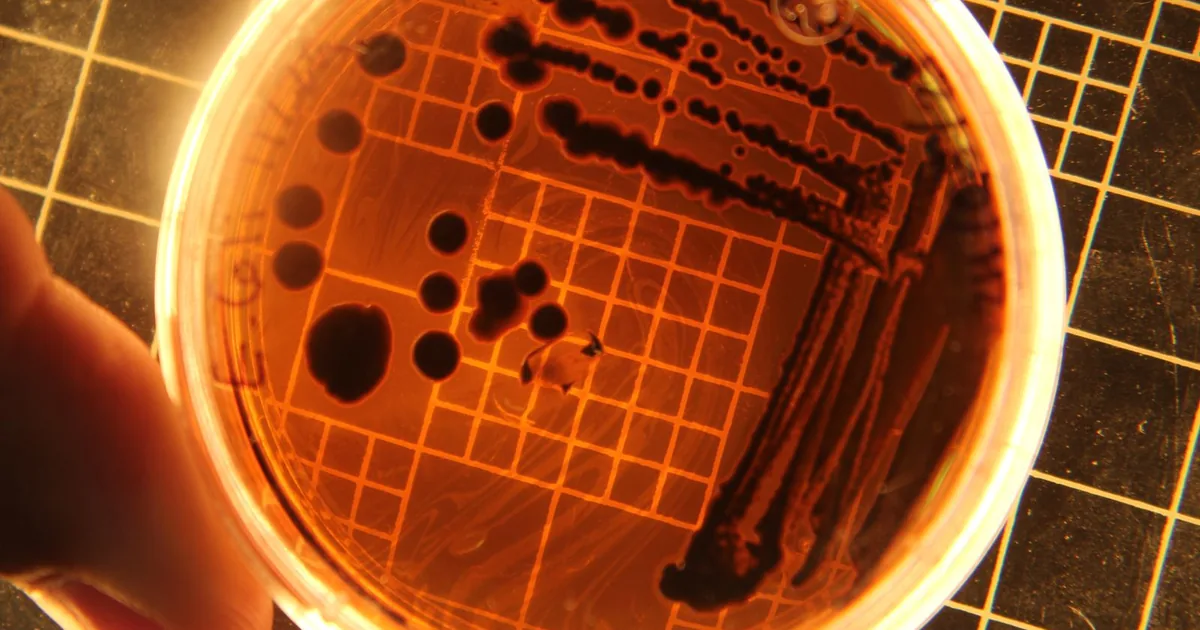
Environmental monitoring (EM) in pharma is the documented programme that measures airborne particles, microorganisms in the air and on surfaces, personnel contamination and physical conditions such as pressure, temperature and humidity in classified areas. Its job is to show that the cleanrooms keep performing as designed, and to detect excursions early enough to protect the product. This guide summarises what EU GMP Annex 1 (2022) requires, the limits it sets for each grade, and how sampling locations follow from the facility design.
Key takeaways
- EU GMP Annex 1 (2022), paragraph 9.2, lists four elements of the monitoring programme: total particles, viable particles (environment and personnel), temperature, relative humidity and other characteristics, and aseptic process simulation for aseptic products.
- Sampling locations, frequency, methods and incubation conditions must come from a documented risk assessment, not from a fixed grid (Annex 1, 9.4).
- Annex 1 sets maximum action limits in Tables 5 and 6. In grade A, any microbial growth triggers an investigation; in grade B the air limit is 10 CFU/m³.
- Grade A must be monitored continuously for particles at a sample flow rate of at least 28 litres (1 ft³) per minute for the full duration of critical processing (Annex 1, 9.16 and 9.17).
- Alert levels are site-specific: they are derived from qualification results and trend data, and must catch deterioration before an action limit is reached (Annex 1, 9.9 and 9.10).
What is environmental monitoring in pharma?
Environmental monitoring is the routine sampling of cleanrooms, clean air equipment and personnel during manufacturing to confirm that contamination stays within defined limits. It does not make a room clean; it provides evidence that the controls designed into the facility, the HVAC system and the procedures are working. Annex 1 (9.1) places the programme inside the site's contamination control strategy (CCS) and warns that no single element, taken alone, proves asepsis. Only the combined results do.
In practice, an EM programme uses a small set of methods, each answering a different question:
| Method | What it measures | Typical use |
|---|---|---|
| Particle counter | Total airborne particles ≥ 0.5 µm and ≥ 5 µm per m³ | Continuous in grade A, recommended in grade B, periodic in C and D |
| Active (volumetric) air sampler | Viable microorganisms per m³ of air (CFU/m³) | Critical zones and their grade B background |
| Settle plate (90 mm) | Microorganisms falling onto an open agar plate (CFU per 4 hours) | Continuous viable monitoring during aseptic operations |
| Contact plate (55 mm) or swab | Microorganisms on equipment, room and gown surfaces (CFU per plate) | Surfaces after operations; gowns of grade A/B operators |
| Glove print | Microorganisms on the five fingers of both gloved hands (CFU per glove) | After critical interventions and on exit from grade B |
| Sensors | Pressure differentials, temperature, relative humidity | Continuous, alarmed, all classified rooms |
What does EU GMP Annex 1 require for environmental monitoring?
EU GMP Annex 1 (2022) requires a documented, risk-based programme that monitors in operation through every critical stage, including equipment set-up. Paragraph 9.4 says the risk assessment should be based on the process, the facility, the equipment, qualification data and the typical microbial flora of the site, and should identify critical monitoring locations: grade A, and the grade B areas that directly interface with it. Air visualisation (smoke) studies are an expected input.
The main operational requirements are:
- Grade A particles: continuous monitoring of ≥ 0.5 µm and ≥ 5 µm particles for the full duration of critical processing, at a flow rate of at least 28 litres (1 ft³) per minute, with alarms on alert levels (9.16, 9.17).
- Grade B particles: a similar system is recommended, at a frequency that still captures any increase in contamination (9.18).
- Grade A viable air: continuous monitoring, for example by air sampling or settle plates, from aseptic set-up to the end of critical processing (9.24).
- Personnel: glove sampling after critical interventions, and glove and gown sampling on each exit from grade B (9.25).
- Outside production: viable sampling after disinfection, before start-up, after a batch and after shutdowns (9.23).
- Identification: microorganisms found in grade A and B must be identified to species level (9.31).
In the United States, FDA's 2004 guidance on sterile drug products produced by aseptic processing likewise expects a written environmental monitoring programme covering all production shifts. USP <1116> adds a trending approach based on contamination recovery rates, the share of samples showing any growth, rather than on single counts. For particle monitoring plans, ISO 14644-2:2015 sets the general requirements.
What are the environmental monitoring limits for each grade?
Annex 1 sets maximum action limits for total particles in Table 5 and for viable contamination in Table 6. The values below are the in-operation limits used for routine monitoring. Sites may set stricter limits through trending or their CCS (9.9).
| Grade | Particles ≥ 0.5 µm/m³ | Air sample CFU/m³ | Settle plate CFU/4 h | Contact plate CFU/plate | Glove print CFU/glove |
|---|---|---|---|---|---|
| A | 3,520 | No growth | No growth | No growth | No growth |
| B | 352,000 | 10 | 5 | 5 | 5 |
| C | 3,520,000 | 100 | 50 | 25 | Not set |
| D | Not predetermined | 200 | 100 | 50 | Not set |
For the larger ≥ 5 µm particles, Table 5 sets 29 per m³ in grade A, 2,930 in grade B and 29,300 in grade C in operation. Annex 1 notes that an occasional ≥ 5 µm count in grade A can be a false count, but repeated low counts should be investigated. These monitoring limits are separate from the classification limits used to qualify the rooms, which are covered in our guide to cleanroom validation.
How do alert levels differ from action limits?
An action limit is the maximum a result may reach before a formal investigation is required; an alert level is a lower, site-specific threshold that signals a drift. Annex 1 (9.9) requires alert levels to be based on qualification results and reviewed against ongoing trend data, so they are calculated from each room's own history rather than copied from the tables.
Paragraph 9.11 lists the trends a procedure must look for: a rising number of excursions, consecutive alert excursions, isolated action excursions with a common cause (for example after every planned maintenance), and changes in the microbial flora, with particular attention to spore-formers and moulds. When an action limit is exceeded, the procedure must require a root cause investigation, an assessment of product impact, including batches made between sampling and reporting, and corrective and preventive actions (9.13).
How should environmental monitoring locations be chosen?
Sampling locations should be the points where contamination is most likely to reach exposed product, sterile surfaces, containers or closures, and their choice must be justified (Annex 1, 9.7). That makes the facility design the starting point: the airflow pattern, the position of the grade A zone, the doors and transfer points, and the routes personnel take all decide where risk concentrates.
A practical sequence is to start from the GMP zoning plan, mark the critical zones and their interfaces, overlay airflow visualisation results and personnel and material routes, and then place samplers where these risks meet. Annex 1 also requires that sampling itself does not disturb grade A and B airflow (9.22), so probe and plate positions should be checked in the smoke studies. Locations are confirmed with qualification data and reviewed as trends accumulate.
What happens after a microbial excursion?

An excursion starts an investigation whose depth depends on the grade and on whether an alert or action level was crossed. For grade A and B, the isolate is identified to species level, and its likely source and impact on each implicated batch are assessed (Annex 1, 9.31). Skin flora point to personnel and gowning, spore-formers and moulds to materials, transfer routes or cleaning gaps.
The outcome often feeds back into the facility: an extra sampling point, a changed transfer route, a revised gowning procedure, or a modified disinfection regime. Additional sample locations may be used to confirm that a corrective action worked (9.23).
Common environmental monitoring mistakes
- Copying a sampling grid from another site or from a classification plan instead of deriving locations from a risk assessment.
- Using Annex 1 action limits as alert levels. Alert levels should come from the room's own data and sit well below the action limit.
- Monitoring only during routine production and skipping set-up, interventions, post-disinfection and restart after shutdown.
- Placing samplers where they are easy to reach rather than where risk is highest, or where they disturb unidirectional airflow.
- Reviewing results one by one without trending the flora, the recovery rate or repeated excursions at the same location.
Frequently asked questions
What are the four types of environmental monitoring in pharma?
EU GMP Annex 1 (2022), paragraph 9.2, lists four elements: total particle monitoring, viable particle monitoring of the environment and personnel, monitoring of temperature, relative humidity and other characteristics, and aseptic process simulation for aseptically manufactured products. Viable monitoring itself combines air sampling, settle plates, contact plates or swabs, and glove prints.
What is the difference between an alert level and an action limit?
An action limit is the maximum result allowed before a root cause investigation, product impact assessment and CAPA are required. An alert level is a lower, site-specific threshold that warns of a drift. Under Annex 1, action limits must not exceed Tables 5 and 6, while alert levels are set from qualification and trend data.
How long can a settle plate be exposed?
EU GMP Annex 1 (2022) sets a maximum exposure of 4 hours for a 90 mm settle plate. In grade A and B, plates are exposed for the whole operation, including set-up, and changed as required. Exposure time must be validated with recovery studies so the agar does not dry out. In grade C and D, exposure and frequency follow quality risk management.
What are the FDA guidelines for environmental monitoring?
For sterile products, the main US reference is FDA's 2004 guidance on sterile drug products produced by aseptic processing. It expects a written environmental monitoring programme covering all production shifts, with sampling locations, frequency and alert and action levels scientifically justified. USP <1116> complements it with guidance on microbiological monitoring and trending of aseptic processing environments.
What does USP <1116> recommend?
USP <1116>, Microbiological Control and Monitoring of Aseptic Processing Environments, recommends trending contamination recovery rates, meaning the percentage of samples that show any microbial growth, rather than relying only on individual colony counts. The approach reflects the low counts and high variability typical of modern aseptic environments, where single results carry little statistical weight.
Is environmental monitoring required in grade C and D areas?
Yes. EU GMP Annex 1 requires in-operation monitoring of grade C and D cleanrooms based on qualification and routine data, with alert and action levels adapted to the operations performed. Table 6 sets viable limits for both grades, but routine gown monitoring is not normally required there. Grade D in-operation particle limits are set by the manufacturer.
How PharmaTwin helps
PharmaTwin is a pharmaceutical facility simulator that models cleanroom grades, the pressure cascade, air change rates and personnel and material flows of a facility in 3D. Those are the inputs an environmental monitoring risk assessment starts from: where the critical zones are, which rooms interface with them and which routes cross them. It does not replace the monitoring programme or the microbiology laboratory; it helps place sampling points on a layout whose risks are already visible.